


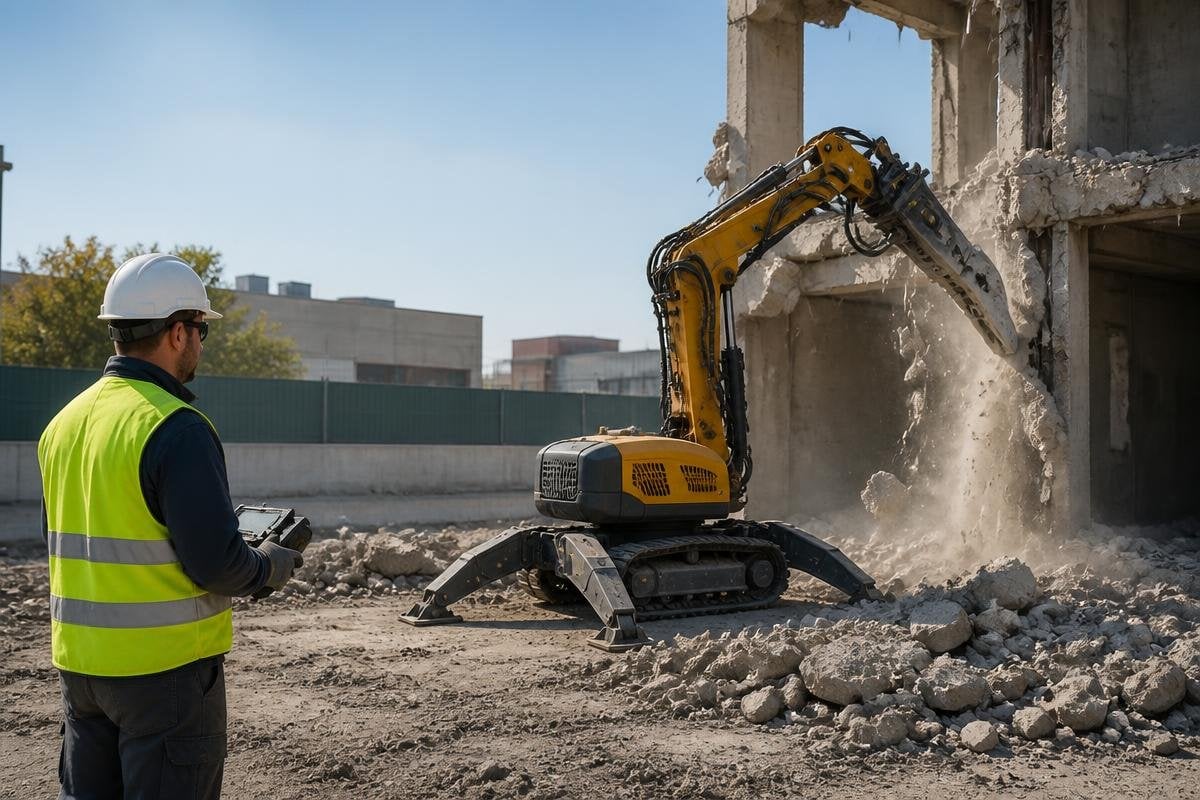
A demolition robot can break concrete while its operator stands well away from falling debris, dust, and unstable floors. That change in position explains much of the interest: the robot takes the worst place on the site, while a person keeps control from a safer spot.
- Remote control keeps the operator away from the work face
- Tracked platforms can work inside damaged or restricted buildings
- Hydraulic tools let one robot break, cut, or remove material
Safety starts with distance
Demolition work can expose people to falling material, vibration, silica dust, heat, and sudden changes in a building’s structure.
A remote-controlled robot moves the operator outside that immediate area, where they can watch the machine through cameras and stop it when conditions change. That distance also helps when a floor, wall, or roof has an uncertain load path. The robot still needs a stable route, but a mistake at the work face does not place a person inside the machine’s reach.
Remote operation does not remove site risk. The operator needs a clear view, a safe position, and a plan for people, vehicles, power lines, and loose material around the robot.
One base, several tools
Most demolition robots use a tracked base, a hydraulic arm, and a tool mounted at the end of that arm. A hydraulic breaker hits concrete, a crusher squeezes it, and a shear cuts metal or other material. The attachment decides much of the work the robot can do.
This setup helps contractors move from one task to another without bringing a person into the most exposed area. One unit can break a slab, then switch to a bucket or grab tool to move smaller pieces, if the model and site plan support that change.
The machine still has limits. A compact robot may fit through a doorway but lack the reach or force needed for thick concrete. A larger robot may work faster yet need more floor space, stronger access routes, and a transport plan.
Access is part of the value
Demolition sites often change by the hour. Doors may be narrow, floors may be uneven, and parts of a building may be closed to people. A small tracked robot can reach places where a larger excavator cannot, while its remote control lets the operator work from outside the room.
That matters in basements, tunnels, industrial buildings, and damaged structures. The robot can also work in areas with poor air quality, where a person would need more protective equipment and tighter exposure controls.
Dust and water still need control. Cameras can become hard to read, tracks can lose grip, and a hydraulic system can fail under heavy use. It remains a work tool, not a substitute for a demolition plan.
The cost section needs more than a price tag. Robot24.com’s demolition robot reports tie a machine to its job and limits, so you can judge whether the bill fits the work.
The costs people miss
The purchase price is only one part of the decision. A site also needs transport, operator training, tool changes, charging or fuel, maintenance, and a way to manage broken concrete and metal after the robot removes them.
This choice makes more sense when the machine can work for long periods, reach a dangerous area, or replace a slower manual task. A small job with easy access may still suit hand tools or a conventional excavator better. I’d choose the robot when exposure risk is high and the site can keep it working.
The open issue is productivity. A machine may reduce risk while taking longer to position, clear, or recharge. Contractors need site records that compare the full task, including setup and cleanup, rather than counting only the minutes when the breaker is running.
A site decision checklist
Use these checks before choosing a demolition robot:
- Map the route: measure doors, ramps, floor strength, turning space, and the distance to the work area.
- Name the hazard: record dust, falling material, heat, weak structures, and any restricted zones.
- Match the tool: confirm that the breaker, crusher, shear, or bucket fits the material and task.
- Plan the view: place the operator where cameras work well and workers can stay clear of the machine.
- Count the full shift: include delivery, setup, tool changes, charging, maintenance, and cleanup.
- Set a stop rule: agree on the conditions that pause work, such as lost camera view or track slip.
These checks point to the reason demolition robots are gaining ground. They put powered tools into places that can be unsafe for people, while keeping a trained operator in control. Their use will grow where the safety gain is clear and the site can support the robot’s size, tools, and working time.