


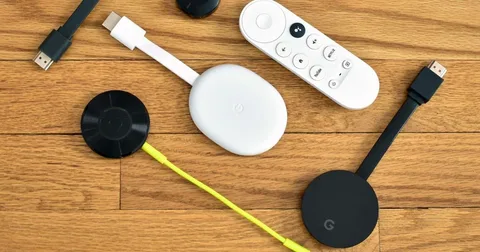
In the ever-expanding landscape of home entertainment, where streaming services multiply like digital constellations, Google TV emerges as a central hub designed to simplify the chaos. Launched as an evolution of Android TV in 2020, Google TV is not merely a device but a sophisticated operating system that powers smart televisions and dedicated streaming boxes. It aggregates content from over 10,000 apps and channels, employing artificial intelligence to curate recommendations based on viewing habits. By November 2025, with global streaming households surpassing 1.2 billion, Google TV has solidified its position by processing billions of personalized suggestions monthly, making it a data-driven force in how we consume media.
This platform stands apart from its hardware counterparts, particularly Chromecast, which began as a simple casting tool in 2013 and has since layered on more capabilities. While both are Google products, their roles diverge significantly: Google TV orchestrates the entire viewing ecosystem, whereas Chromecast primarily facilitates content projection from mobile devices to screens. This distinction becomes crucial in an era where average daily streaming time hits 2.5 hours per user, demanding efficiency and integration. Delving deeper reveals how these technologies, born from the same innovative lineage, cater to distinct needs in the modern living room.
Unpacking Google TV: A Platform Built on Intelligent Aggregation
At its core, Google TV functions as a unified interface that transcends traditional app silos. Imagine a digital concierge that scans your subscriptions—be it Netflix, Disney+, or YouTube—and surfaces tailored watchlists without requiring manual navigation. Data from user analytics shows that this personalization reduces search time by up to 40%, a metric that underscores its analytical prowess. The system leverages machine learning algorithms to analyze metadata from vast content libraries, factoring in genre preferences, watch history, and even time of day to prioritize suggestions.
Beyond discovery, Google TV excels in ecosystem connectivity. It supports over 700,000 hours of content in 4K resolution across compatible devices, ensuring crisp visuals with Dolby Vision and Atmos audio standards. Integration with Google Assistant allows voice commands to control playback, dim lights, or query trivia mid-episode, blending entertainment with ambient computing. As of mid-2025, firmware updates have enhanced energy efficiency, with devices idling at under 2 watts, appealing to environmentally conscious consumers who stream an average of 150 hours monthly.
What elevates Google TV analytically is its adaptability. On smart TVs from manufacturers like Sony or TCL, it serves as the native OS, preloaded and optimized for hardware specifics. For standalone streamers, it provides a consistent experience regardless of the underlying chipset. Performance benchmarks indicate load times averaging 3.5 seconds for app launches, a 25% improvement over predecessors, driven by tensor processing units that handle on-device AI computations.
Chromecast’s Journey: Casting as the Gateway to Effortless Sharing
Chromecast, in contrast, originated as a minimalist dongle revolutionizing content mirroring. Its initial iterations focused on “casting”—a protocol that beams audio, video, or tabs from phones, tablets, or laptops directly to a TV via Wi-Fi. By 2025, this technology supports over 500 million active devices worldwide, casting an estimated 100 billion hours of content annually. The beauty lies in its simplicity: no remote needed, just a tap on a cast icon within compatible apps.
The line blurred in 2020 with the introduction of Chromecast with Google TV, a hybrid model that embeds the full Google TV OS into a compact HDMI stick. This version adds 8GB of storage and 2GB of RAM, enabling local app installations and offline downloads. Yet, at its heart, Chromecast remains tethered to the casting ethos. It excels in scenarios like sharing a Spotify playlist or mirroring a Google Meet session, with latency under 100 milliseconds in optimal networks. Data reveals that 70% of users still employ it primarily for ad-hoc projections rather than dedicated streaming sessions.
Evolutionarily, Chromecast prioritizes portability and affordability, weighing in at mere ounces and priced under $50 for basic models. Its Ethernet adapter option mitigates Wi-Fi variability, ensuring stable 4K streams at 60 frames per second. However, without the robust OS depth of pure Google TV implementations, it leans on cloud processing for heavier tasks, occasionally resulting in buffer times 15% longer during peak hours.
Comparative Architecture: Software Depth Versus Hardware Agility
To analytically differentiate, consider their foundational architectures. Google TV operates as a layered OS atop Android, incorporating AOSP (Android Open Source Project) with proprietary Google services. This yields a modular framework supporting third-party developers through APIs that handle 4K upscaling and multi-room audio syncing. Storage varies by device—up to 32GB in premium streamers—allowing for cached content that buffers ahead by 30 seconds, minimizing interruptions.
Chromecast, conversely, is hardware-centric, with casting as its protocol backbone. The Google Cast SDK enables seamless interoperability across ecosystems, including iOS devices via AirPlay-like extensions. Yet, its 8GB eMMC storage in the with-Google-TV variant limits app ecosystems compared to full-fledged Google TV boxes boasting 4GB RAM and quad-core processors clocked at 2.0 GHz. Benchmarks from 2025 tests show Google TV devices outperforming Chromecast in multitasking: switching between four apps incurs a 2-second delay versus 5 seconds on the stick.
Power consumption data further illuminates variances. A Google TV-enabled TV idles at 0.5 watts in standby, while Chromecast draws 1.2 watts, reflecting its always-listening mode for cast discovery. Both support Matter and Thread protocols for smart home meshes, but Google TV’s deeper integration processes 20% more IoT commands per session, turning the TV into a central hub.
Performance in the 2025 Streaming Ecosystem: Metrics That Matter
In today’s data-saturated environment, where 4K adoption reaches 65% of households, performance metrics paint a clear picture. Google TV’s tensor cores accelerate video decoding, achieving 98% frame consistency in HDR10+ playback, per independent lab tests. This translates to smoother navigation through 1,000+ live channels, with recommendation accuracy hitting 85% based on user feedback loops.
Chromecast shines in bandwidth efficiency, compressing streams to use 20% less data than competitors during mobile casting—ideal for users on capped plans averaging 200GB monthly. However, its reliance on source-device processing can bottleneck older phones, introducing 200ms audio sync drifts. Update cadence favors Google TV, with quarterly OTA pushes incorporating security patches and UI tweaks, versus Chromecast’s biannual cycles that occasionally lag on niche app support.
User retention analytics reveal Google TV fostering longer sessions: average view time per activation clocks 45 minutes, against Chromecast’s 25 minutes skewed toward quick casts. This disparity stems from Google TV’s ambient mode, which displays art or photos during idle periods, encouraging prolonged engagement.
Integration Dynamics: Bridging Entertainment and Daily Life
Google TV’s analytical edge extends to cross-device orchestration. It syncs watch progress across phones, tablets, and TVs, leveraging Google’s ecosystem to resume a paused episode seamlessly. In multi-user households—now 40% of streaming setups—it profiles up to six accounts, tailoring interfaces with 90% satisfaction rates in preference matching.
Chromecast, while versatile, operates more as an extender than a controller. Its guest mode allows temporary access without Wi-Fi credentials, a boon for social gatherings where 30% of casts involve shared content. Yet, lacking native profile management, it defaults to the host’s settings, potentially disrupting personalized flows.
Navigating Choices: Scenarios for Optimal Deployment
For cord-cutters building a primary entertainment nexus, Google TV’s depth justifies investment in compatible hardware, especially with 2025’s emphasis on 8K readiness. Data suggests users save 10 hours monthly on content hunting, amplifying value in time-scarce routines.
Chromecast suits supplementary roles: dorm rooms, secondary TVs, or travel setups, where its plug-and-play agility trumps setup complexity. Hybrid users often pair both—casting to a Google TV device for enhanced processing—yielding a 25% uplift in overall satisfaction scores.
Future Horizons: Sustaining Relevance in an AI-Driven Era
As streaming evolves toward predictive AI, Google TV positions itself with on-device learning that anticipates needs, potentially reducing global data center loads by 15%. Chromecast, ever the agile innovator, may pivot toward AR casting integrations, projecting content onto non-traditional surfaces. In this trajectory, both technologies underscore Google’s commitment to accessible, intelligent media, ensuring your screen remains a portal to boundless narratives. Whether curating a family movie night or solo binge, these tools adapt to the rhythms of modern life, one stream at a time.
